


After using sAInthetic across a few real client projects, it stopped feeling like “another AI toy” and started feeling like a core part of my marketing stack. Instead of staring at a blank page every time I need a new campaign, I open the app, pick a persona, and instantly have a full board of prompts ready for blogs, email sequences, social posts, case studies, and more. The difference in speed is obvious: what used to take me a couple of hours of brainstorming now takes a few minutes, and the quality of the ideas is noticeably closer to what my ideal customers actually care about.
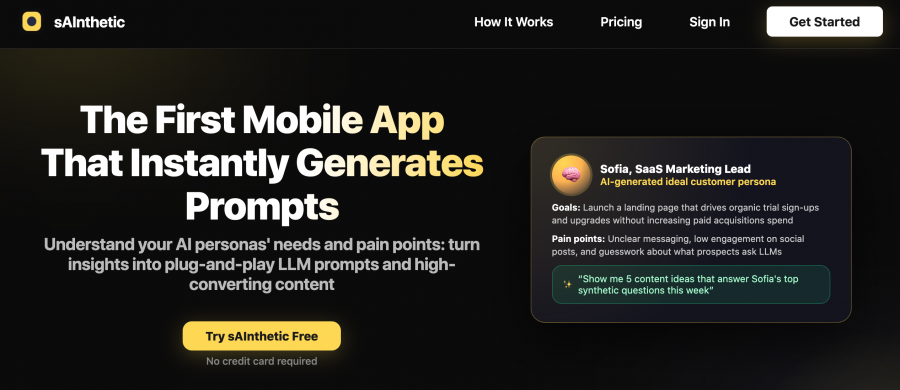
What surprised me most is how consistent the messaging becomes when everything starts from the same set of personas. Once a persona is defined, every prompt generated for that profile keeps the same pain points, desired outcomes, tone of voice, and level of sophistication. That means the blog article, the onboarding email, and the LinkedIn post no longer feel like three separate pieces written in isolation; they feel like parts of a single, coherent narrative speaking to the same person. For brands that struggle with fragmented messaging across channels, this alone is a big win.
I also found sAInthetic particularly useful for testing new angles before putting real budget behind them. By generating prompts tailored to different personas, I can quickly explore variations in positioning—more ROI‑driven, more emotional, more technical—and then run those through my favorite LLM to see which ideas turn into the strongest copy. It becomes a lightweight “concept lab” for campaigns, without needing to brief a copywriter from scratch every time. When you’re running multiple experiments in parallel, that agility makes a huge difference.
From a workflow point of view, the app fits neatly into how I already work. I don’t have to learn a complex system or switch tools completely; I just log into sAInthetic, generate prompts that are persona‑aware and channel‑specific, and paste them into ChatGPT or my other AI tools. The prompts are structured enough that the AI outputs are usually usable on the first try, which cuts down on the back‑and‑forth rewriting that normally eats up time. Over a few weeks, the compounding effect of this time‑saving starts to show up directly in how much more content I’m able to ship.
If you work in marketing, growth, content, or you’re a founder who needs to communicate clearly with a very specific audience, using something like sAInthetic quickly becomes a competitive advantage. It gives you sharper starting points, keeps your brand voice aligned with each persona, and makes experimentation with new offers and messages much cheaper and faster. In my experience, it’s one of those tools that quietly moves you from “I know I should be more consistent with personas” to actually operationalizing personas every single day.
What also became clear to me over time is how sAInthetic actually fits into the way I plan and execute campaigns. My typical flow now starts with defining or refining a persona inside the app: role, industry, responsibilities, goals, frustrations, decision criteria, and the kind of language they naturally use. Once that foundation is in place, I move over to the Prompts section, select the persona from the dropdown, and instantly see a board of prompts grouped by format—blog, email, social, website, case study, and more. Each card already “thinks” like that persona, so I’m not just generating random content ideas, I’m generating ideas that are tightly anchored to a real buying context.
From there the workflow is straightforward. When I see a prompt that looks promising, I copy it and drop it into my favorite AI writing tool. Because the prompt already includes persona details, pain points, and a clear angle, the AI has much better context than it would from a generic instruction. I usually ask the AI to produce a first draft, then come back to sAInthetic, pick another prompt for a different stage of the funnel or a different channel, and repeat. In a single working session I can cover awareness, consideration, and conversion assets that all share the same persona logic, without having to re‑engineer the brief each time.
Another thing I’ve come to appreciate is how easy it is to keep my personas “alive” instead of treating them as static documents. Whenever I learn something new about a segment—maybe a fresh objection from a sales call or a new success metric from a customer—I can jump into the persona in sAInthetic, update a few fields, and then immediately regenerate prompts. The new prompts reflect that learning right away. This turns personas from dusty slides in a strategy deck into a living system that actively shapes the next piece of content I create.
The app is also surprisingly comfortable to use on mobile. I’ve used it from my phone while commuting, between meetings, or sitting on the sofa in the evening. The interface scales nicely to a smaller screen: the sidebar, persona selector, and prompt cards are all readable and tappable without feeling cramped, so it doesn’t feel like I’m wrestling with a desktop interface squeezed into a phone. That means I can sketch out a batch of prompts while I’m away from my laptop, then later paste them into my AI tool of choice when I’m back at my desk. For someone who likes to capture ideas on the go, this mobile‑friendly setup is genuinely useful.
In practice, this mobile experience has changed when and where I do my thinking work. Instead of waiting for a long uninterrupted block of time, I can open sAInthetic on my phone, pick a persona, and quickly generate prompts for a new campaign while I’m on the move. I’ll often favorite or screenshot a few of the best ones, so when I sit down later I already have a shortlist of ideas to turn into full assets. It’s a small shift, but it means my best strategic thinking doesn’t get trapped at my desk; I can work with my personas whenever inspiration hits.
Overall, my experience with sAInthetic is that it gives structure to both my strategy and my creativity. It keeps me honest about who I’m talking to, while giving me a fast, repeatable way to turn that understanding into concrete prompts for content, ads, onboarding flows, and more. The fact that I can do all of this just as easily from my phone as from my laptop makes it much more likely that I actually use it every day, instead of letting it become another forgotten tool. If you want your AI content to stop sounding generic and start sounding like it was written with a specific person in mind, sAInthetic is the kind of webapp that quietly upgrades the way you work.